

What's New
Displaying results 181 - 190 of 4924
Resource | Publications,
A vigorous follow-up and appraisal system for the implementation of the 2030 Agenda for Sustainable Development requires a streamlined process of reporting the agreed framework of indicators and statistical data to monitor progress, inform policy and ensure accountability of all stakeholders. The Voluntary National Reviews (VNRs) is a testimony to each country’s continued commitment to support and implement the 2030 Agenda for Sustainable Development and its 17 Sustainable Development Goals (SDGs). It is paramount to have data available to report and monitor the progress in the SDGs of each country. UNICEF set out a regional research initiative to understand the uptake and reporting of 44 child-focused SDG indicators in the VNRs presented by the countries of East Asia and the Pacific Region. This report also analyzed the availability of data for these indicators since 2010. The report outlined the notable variation in the uptake of child-focused indicators in VNRs and data availability across various SDG areas and across countries in the EAP region by different country groupings. The report also highlighted the responsibilities and key actions required to increase the uptake as well as the data availability that the national authorities should consider in the future.

Resource | Fact Sheets,
In November 2022, there were 1,251 confirmed HIV-positive individuals reported to the HIV/AIDS & ART Registry of the Philippines (HARP) and were accounted to the total (108,428) reported cases since January 1984. Moreover, 288 (23%) of individuals reported in November had advanced HIV infection at the time of diagnosis. Forty three deaths were newly reported, bringing the total deaths this year to 919.
Resource | Fact Sheets,
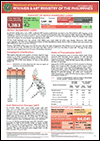
In October 2022, there were 1,383 confirmed HIV-positive individuals reported to the HIV/AIDS & ART Registry of the Philippines (HARP) and were accounted to the total (107,177) reported cases since January 1984. Moreover, 353 (26%) of individuals reported in October had advanced HIV infection at the time of diagnosis. Sixty-five deaths were newly reported, bringing the total deaths this year to 878.
Resource | Fact Sheets,
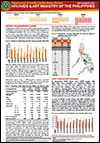
In September 2022, there were 1,347 confirmed HIV-positive individuals reported to the HIV/AIDS & ART Registry of the Philippines (HARP). This was a 37% increase compared to the same reporting period last year (981). Three hundred fifty-five (26%) had clinical manifestations of advanced HIV infection at the time of testing.

Resource | Fact Sheets,
In August 2022, there were 1,346 confirmed HIV-positive individuals reported to the HIV/AIDS & ART Registry of the Philippines (HARP) and were accounted to the total (104,458) reported cases since January 1984. Moreover, 368 (27%) of individuals reported in August had advanced HIV infection at the time of diagnosis. Two hundred twenty deaths were newly reported, bringing the total deaths this year to 541.
Resource | Reviews and Snapshots,
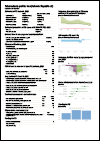
Tuberculosis profiles are generated automatically based on data reported by countries and which are held in WHO's global TB database. The document includes data for estimates of TB burden, UHC and social protection, TB/HIV care in new and relapse TB patients, drug-resistant TB care in the country.
Resource | Publications,
UNDP’s Strategic Plan 2022–2025 and HIV and Health Strategy 2022-2025 view open and inclusive civic spaces as central to achieving broader structural changes to build resilient societies able to respond to conflicts and crises and ensuring that no one is left behind.
Resource | Publications,
This issue brief shares lessons and reflections on enabling legal environments, including decriminalisation, to inform the implementation of key commitments in the 2021 Political Declaration on HIV and AIDS and the Global AIDS Strategy. These include a shared understanding of the harms caused by the overly broad and unjust application of criminal laws; sensitization of key stakeholders and their engagement in legal review processes; A well-informed judiciary; Coordinated, multi-pronged and multisectoral legal advocacy; and, global and regional advocacy to advance national-level changes to HIV-related punitive and discriminatory laws, including decriminalization.
Resource | Publications,
This issue brief shares lessons and reflections on the role of the judiciary in advancing rights-based HIV responses, to inform the implementation of key commitments in the 2021 Political Declaration on HIV and AIDS and the Global AIDS Strategy. These include an understanding of the critical nature of judicial decisions in shaping the HIV-related legal environment; the important legal implications of evolving HIV science; sensitizing judges to people’s lived experiences is key; and safe spaces for respectful discussion and learning among justice sector peers.
Resource | Publications,
This issue brief shares lessons and reflections on the importance of regional spaces for strengthening responses, to inform the implementation of key commitments in the Political Declaration on HIV and AIDS and the Global AIDS Strategy. These include an appreciation that convening stakeholders in regional spaces can be safer than in national spaces; regional-level discussions can foster peer-to-peer knowledge exchanges; regional level networking can lead to a network of in-country allies; and importance of regional economic communities for aligning national HIV-related laws with human rights commitments.