

What's New
Displaying results 1 - 10 of 4934
Resource | Publications,
Adopts the political declaration entitled “Political Declaration on HIV/AIDS: United to End AIDS by 2030” annexed to the present resolution.
Resource | Publications,
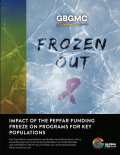
In 2024, the total PEPAR budget for KP-focused HIV testing, treatment, prevention, and wraparound services was $415.4M. At the highest end, this gure represents the total budget needed to maintain KP-focused programs at the current state in a worst case scenario in which PEPFAR terminates all of these programs. The largest gaps would be seen in Eastern and Southern Africa, where the average PEPFAR country budget for all KP-focused programs is $12.7M, followed by Asia ($7.8M), Eastern Europe and Central Asia ($6.8M), Western and Central Asia ($6.0M), and Latin America and the Caribbean ($3.3M).

Resource | Publications,
Asia and the Pacific — Regional profile — 2025 Global AIDS Update — AIDS, Crisis and the Power to Transform
In 2024, 6.9 million [6.2 million–7.8 million] people living with HIV were residing in Asia and the Pacific, making this the world’s largest epidemic after that in eastern and southern Africa. Asia and the Pacific accounts for almost a quarter of annual new HIV infections globally (23%).

Resource | Publications,
On 10th of July, UNAIDS launched its 2025 Global AIDS Update, “AIDS, Crisis and the Power to Transform”, which shows that a historic funding crisis is threatening to unravel decades of progress unless countries can make radical shifts to HIV programming and funding.

Resource | Publications,
What the data tell us: projections for the HIV epidemic in AP region in 2030 and beyond

Resource | Publications,
UNAIDS' Data Book - HIV country profiles provide an overview of the latest available data on the HIV epidemic and response in the countries from 2024.

Resource | Publications,
The People Living with HIV Stigma Index is a standardized tool to gather evidence on how stigma and discrimination impact the lives of people living with HIV.
It was developed to provide much-needed data and evidence that could be used to advocate for the rights of people living with and affected by HIV. The results of HIV Stigma Index 2.0 in Thailand are now available.

Resource | Publications,
The 2024 Population Size Estimation (PSE) exercise followed a geographical mapping approach similar to the 2010 and 2016 exercises. In addition, three other methods were used to estimate the size of key populations: the capture-recapture method, network scale-up, and service multiplier methods.
This survey aimed to generate both sub-national and national level estimates of the size of key populations targeted by HIV-related interventions managed at the district level in collaboration with national, local partners, and community organizations.

Resource | Publications,
A successful AIDS response should be measured by the achievement of concrete, timebound targets, accompanied by careful monitoring of the progress in implementing the commitments of the 2021 Political Declaration on AIDS.
The Global AIDS Monitoring (GAM) framework helps to structure and organize collective global monitoring efforts. It is based on the structure of the Political Declaration, using eight core focus areas, linked to three global AIDS strategic priorities.

Resource | Publications,
This report focuses on one of these essentials—the central role of human rights as it relates to ensuring access to HIV prevention and treatment services and addressing the structural determinants that increase vulnerability to HIV.