



What's New
Displaying results 301 - 310 of 4924
Resource | Publications,
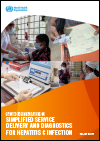
This policy brief, one of two on the updated hepatitis C (HCV) guidelines, focuses on the new recommendations on simplified service delivery for a public health approach to HCV testing, care and treatment. These recommendations include decentralization, integration and task-sharing, in addition to the use of point-of-care (POC) HCV viral load assays and reflex viral load testing.
Resource | Publications,
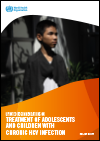
This policy brief focuses on the new recommendations on treatment of adolescents and children aged 3 years or older with chronic hepatitis C virus (HCV) infection.
Resource | Publications,
This guide aims to help advance progress on the path to HIV epidemic control by providing HIV service providers with a practical framework to direct and advance the evolution of evidencebased, client-centered strategies to minimize the HIV risks associated with sexualized drug use, particularly among men who have sex with men (MSM).
Resource | Publications,
This new Road Map charts a way forward for country-level actions to achieve an ambitious set of HIV prevention targets by 2025. Those targets emerged from the 2021 Political Declaration on HIV and AIDS, which the United Nations General Assembly adopted in June 2021 and they are underpinned by the Global AIDS Strategy (2021–2026). The Strategy sets out the principles, approaches, priority action area and programmatic targets for the global HIV response.
Resource | Publications,
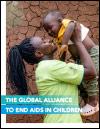
An end to AIDS in children, achieved through a strong, strategic, and action-oriented alliance of multisectoral stakeholders at national, regional, and global levels that works with women children and adolescents living with HIV, national governments, and partners to mobilize leadership, funding, and action to end AIDS in children by 2030.
Resource | Tools,
The monitoring tool is divided into two parts. The first part addresses epidemiological trends in mother-to-child transmission in prison, with a view to collecting the epidemiological data needed to monitor progress towards the global targets on prevention of mother-to-child transmission.
The second part covers access to health care and social services needed within the prison setting in order to reach the 2025 HIV targets. Indicators in this second part include information on the availability and coverage of relevant services. Public health-care priorities as set in the UNODC technical guidance documents are taken into consideration, as is the protection of human rights, women’s rights, privacy and confidentiality.
Resource | Presentations,
Asia and the Pacific presentation for EF webinar
Resource | Guidelines,
The Consolidated guidelines on HIV, viral hepatitis and STI prevention, diagnosis, treatment and care for key populations outline a public health response for 5 key populations (men who have sex with men, trans and gender diverse people, sex workers, people who inject drugs and people in prisons and other closed settings). They present and discuss new recommendations and consolidate a range of recommendations and guidance from current WHO guidelines.
Particularly for key populations, social, legal, structural and other contextual factors both increase vulnerability to HIV, viral hepatitis and STIs and obstruct access to health and other essential services. These guidelines highlight the critical importance of addressing structural barriers in all settings as a priority.
Resource | Publications,
This technical brief aims to support these trends, accelerated by the COVID-19 pandemic, and improve PrEP uptake, persistence, and effective use by providing implementation guidance for differentiated and simplified service delivery. The brief aims to support a range of stakeholders in planning and implementing PrEP services and supplements and updates previously published WHO PrEP implementation guidance.
Resource | Publications,
The new strategies propose a common vision to end epidemics and advance universal health coverage, primary health care and health security in a world where all people have access to high-quality, evidence-based and people-centred health services. The GHSS promote the disease-specific goals to end AIDS and the epidemics of viral hepatitis and sexually transmitted infections by 2030, with 5 strategic directions providing the overall guiding framework for achieving these goals.