

Publications on People Living With HIV (PLHIV)
Resource | Publications,
In April 2019, WHO convened an expert scoping consultation in Geneva, Switzerland consisting of policy-makers, academics and partners from the HIV, noncommunicable diseases and mental health communities to discuss current evidence of chronic noncommunicable disease, the burden and risk among people living with HIV, review current norms and standards and ultimately to set priorities for technical areas and interventions for co-managing major non communicable diseases and mental health conditions among people living with HIV; and to inform the update of the 2016 WHO HIV consolidated guidelines on the use of antiretroviral drugs for treating and preventing HIV infection.
Resource | Publications,
Other key and evolving needs during the pandemic that, if left unaddressed, will continue to have a devastating impact on the health, well-being, and human rights of people at risk of or living with HIV include: increased mental health issues (anxiety, depression, trauma), gender-based violence (GBV) and violence at the hands of law enforcement and security structures, as well as lack of access to technology for information, care and services which have increasingly shifted on-line. Throughout this period, communities and CBOs have demonstrated incredible resilience, flexibility, and creativity in meeting their own needs—as they always have—and examples are shared in this report.
Resource | Publications,
These guidelines provide new and updated recommendations and good practice statements in the following areas: starting ART, including initiating treatment outside the clinic and support for same-day ART start; frequency of clinical visits and ART refills; measuring adherence; tracing and re-engagement in care for all populations; psychosocial support for adolescents living with HIV; task sharing for diagnostic services; and service integration.
This guideline seeks to provide support to Member States, programme managers, health workers and other stakeholders seeking to achieve national and international goals to end the HIV epidemic as a public health threat by 2030.
Resource | Publications,
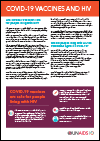
The COVID-19 vaccines under development or approved by regulators are believed to be safe for most people, including people living with HIV.
Resource | Publications,
This report provides a summary of key developments in the legal environment for HIV responses in Asia and the Pacific. It is the product of a desk review conducted for UNAIDS and the United Nations Development Programme (UNDP) in 2019. The report highlights key trends and developments in laws affecting people living with HIV and key populations in Asia and the Pacific over the five-year period 2014–2019.
Resource | Presentations,
Availability of disaggregated data is crucial for informed response against the HIV epidemic in the country. NCASC has developed and implemented the HIV Care and ART Tracking System to ensure the availability of HIV testing and treatment-related data in real-time at the national and subnational level. This is the first time that NCASC has analyzed and disseminated the top ten causes of death, LTFU and missing situation of PLHIV using disaggregated data.
Resource | Publications,
A participatory research tool was developed collaboratively by Dristi Nepal (hereafter ‘Dristi’), and ITPC to capture and assess the impact of Covid-19. The qualitative survey tool used images and emoticons to encourage participants, regardless of literacy, to relate their experiences of healthcare services as people living with HIV, and to rank their government’s actions on health provisions and human rights both prior to and during the Covid-19 pandemic. Every component of the tool’s development and implementation was collaborative, from the formulation of indicators, to its inclusive design and analysis of findings.
Resource | Publications,
UNAIDS calls on governments to live up to their 2030 Agenda for Sustainable Development commitment to leave no one behind by strengthening social protection systems, including the set of minimum standards known as “floors”, in the face of the COVID-19 pandemic and by enhancing the responsiveness of social protection systems to people’s basic and changing needs and vulnerabilities—in particular for people living with, at risk of and affected by HIV, including key populations and young people, women and girls, people living with disabilities, refugees, asylum seekers, migrants and populations in a state of food insecurity or malnourishment and in humanitarian settings. These groups of people are among the high-risk populations for COVID-19 and are especially vulnerable to economic, spatial and social inequalities and disruptions in the provision of, and effective access to, basic services and social assistance.
Resource | Publications,
Part of the ILO series on leaving no one behind in COVID-19 and the world of work, this brief describes the impact of the pandemic on people living with HIV and makes recommendations for a COVID-19 response and recovery in the world of work that is inclusive of people living with HIV.