




Publications on Migrants
Resource | Publications,
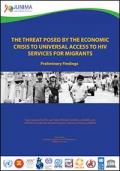
The objective of this paper is to give an overview of the potential impact of the current crisis on migrant and mobile populations in Southeast Asia, and assess how the likely increase in unsafe mobility with its accompanying risks and vulnerabilities for HIV transmission will affect the health of people on the move.
Resource | Fact Sheets,
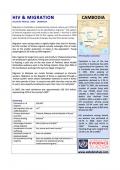
Cambodia is one of the few countries in Southeast Asia with a generalised HIV epidemic. HIV in Cambodia was first detected in 1991. After peaking at approximately 3.3% in 1998, HIV prevalence among the adult population declined to 1.2% in 2003, and further down to 0.9% in 2005.
Resource | Fact Sheets,
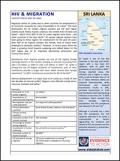
Migration within Sri Lanka and to other countries for employment is an economic necessity for many households in Sri Lanka. The main destinations for Sri Lankan migrant workers are the Gulf region (mainly Saudi Arabia, Kuwait, Lebanon, the United Arab Emirates and Qatar) ‐ which hires 90% of the Sri Lanka migrant work force ‐ and other countries in the Asia Pacific. Sri Lankan migrant workers have been going to these regions for employment for the past 20 years. Over half of all migrant workers are female, 91% of whom were employed as domestic workers. However, in recent years, there has been a growing trend towards supplying semi‐skilled labour to the Gulf region due to its improved educational attainment and construction boom.
Resource | Fact Sheets,
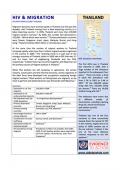
Migration dynamics have evolved rapidly in Thailand over the past few decades, with Thailand moving from a labor‐exporting country to a labor‐importing country.
Resource | Fact Sheets,
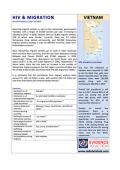
Exporting migrant workers is part of the Vietnamese government’s mandate, with a target of 75,000 workers per year, increasing to 100,000 by 2010. In 2006, Vietnam sent out 78,855 migrant workers, 35% of whom were female.
Resource | Fact Sheets,
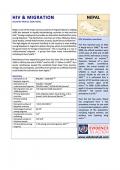
Nepal is one of the major source countries of migrant laborers, helping fulfill the demand in rapidly industrializing countries in Asia and the Gulf. Foreign employment provides an alternative livelihood for many young Nepalese.
Resource | Fact Sheets,
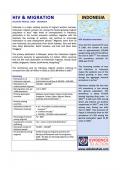
Indonesia is a major sending country of migrant workers overseas. Indonesian migrant workers are among the fastest‐growing migrant population in Asia. High levels of unemployment in Indonesia, particularly in the current economic condition, together with the relatively low earnings of workers, will continue to encourage Indonesians to seek employment abroad.
Resource | Publications,
Worldwide, far more people migrate within than across borders, and although internal migrants do not risk a loss of citizenship, they frequently confront significant social, financial and health consequences, as well as a loss of rights. The recent global financial crisis has exacerbated the vulnerability internal migrants face in realizing their rights to health care generally and to antiretroviral therapy in particular.
Resource | Publications,
Migrant workers in India play a key role in the spread of HIV. Kolkata is a common destination for workers, who may acquire infection and transmit it to their wives and/or other sexual partners. We investigated sexual relations and condom use by factory workers.
Resource | Publications,
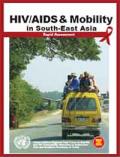
This document presents the key findings and recommendations of a rapid assessment conducted on HIV and mobility issues in the 10 ASEAN Member Countries in 2007-2008. It includes the migration patterns and HIV situation across the region, and the challenges and opportunities facing South-East Asian countries as they work together to develop a comprehensive response to HIV for migrant and mobile populations.